
By Jeffrey T. Donner, Esq.
September 10, 2026
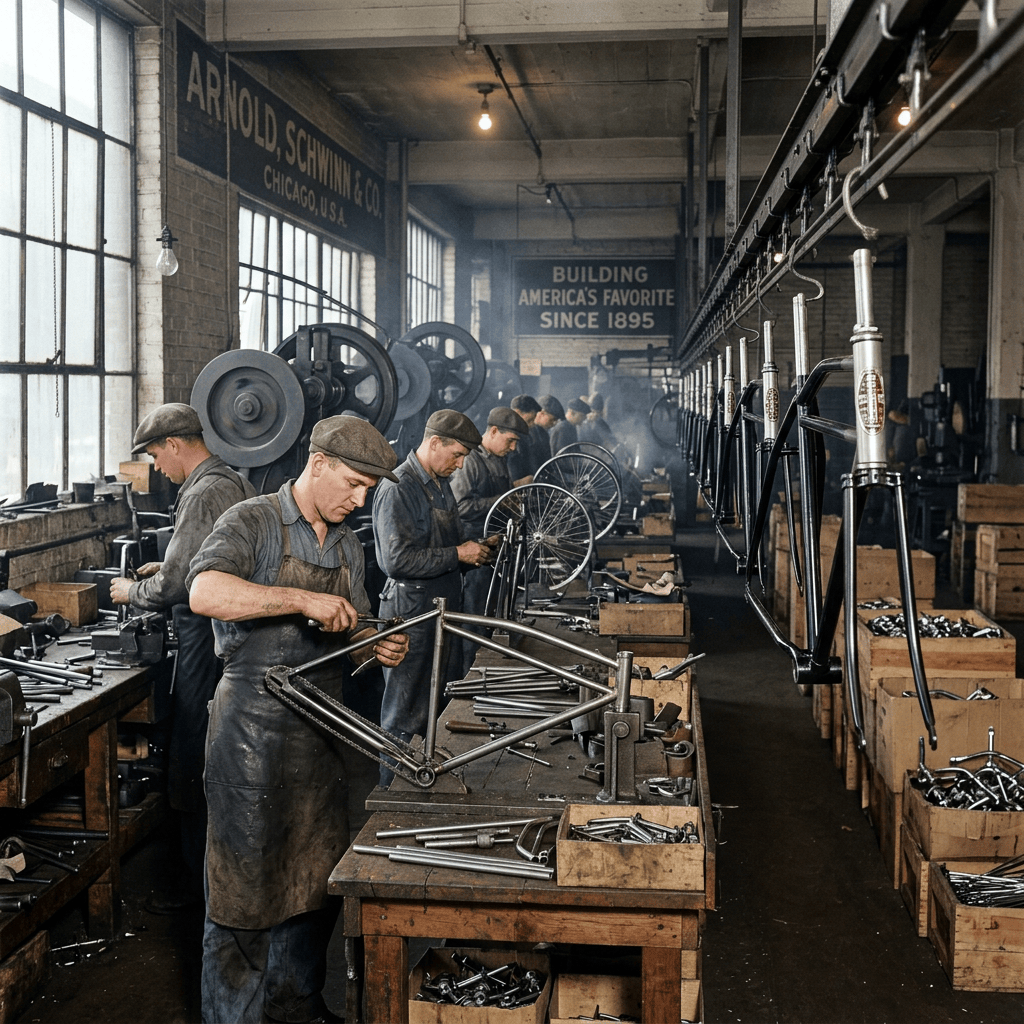
There is something almost allegorical about the histories of Schwinn and Giant. For much of the twentieth century, Schwinn was not merely an American bicycle company; it was the American bicycle company. Schwinn bicycles were manufactured in Chicago, sold through an extensive dealer network, and deeply embedded in American popular culture. Giant, by contrast, was founded in Taiwan in 1972 as a manufacturer that few American consumers had ever heard of. Giant’s original business was not principally to persuade consumers to buy a Giant bicycle. It was to manufacture bicycles for other companies whose names consumers already knew.
One of those companies was Schwinn. Giant began producing bicycles for Schwinn in 1977, and the relationship became extraordinarily important to both businesses. By the mid-1980s, historical accounts indicate that Giant was producing more than two-thirds of Schwinn’s bicycles and that Schwinn, in turn, accounted for approximately three-quarters of Giant’s business. On paper, Schwinn still appeared to occupy the superior position. Schwinn owned the famous trademark, controlled the dealer relationships, understood the American market, possessed generations of accumulated goodwill, and presumably regarded Giant as an important but replaceable supplier.
Today the positions are almost reversed. Giant is one of the world’s major bicycle manufacturers and a genuine premium bicycle brand. It designs sophisticated carbon-fiber road bicycles, invests in engineering and research, operates manufacturing facilities, sells through an international distribution system, and supplies bicycles capable of competing at the highest levels of professional cycling. Schwinn still exists as well, but the continuing existence of the Schwinn name illustrates the entire problem. What survives is principally a brand. The great American industrial enterprise that once stood behind that brand—the factories, manufacturing workforce, accumulated production knowledge and vertically integrated organization—is gone.
That difference between the survival of a trademark and the survival of an industrial capability is much more important than it first appears. The history of Schwinn and Giant is not merely a story about bicycles. It is a compact illustration of a much broader transformation in the American economy: the gradual separation of ownership, branding, management, finance and marketing from the physical knowledge required to make things.
When the Supplier Learns More Than the Customer
The conventional way to understand outsourcing is to imagine that the customer retains the valuable intellectual functions while transferring routine production to a lower-cost supplier. The American company designs the product, owns the brand and understands the consumer, while a foreign factory performs the relatively simple task of manufacturing it. From that perspective, the relationship appears naturally hierarchical. The company controlling the brand occupies the commanding heights of the value chain; the factory merely follows instructions.
The weakness in that model is that manufacturing is not simply the mechanical execution of knowledge created somewhere else. Manufacturing itself creates knowledge. Every bicycle Giant produced for Schwinn gave Giant’s employees, engineers, managers and suppliers additional experience with metallurgy, welding, tubing, tooling, paint, tolerances, assembly, quality control, sourcing, production engineering and logistics. Problems arose and were solved. Processes were improved. Suppliers were identified and evaluated. Engineers learned what designs worked not merely on paper but in production. Workers accumulated practical knowledge that could never be completely reduced to a drawing or instruction manual.
Economists sometimes describe this as tacit knowledge: expertise residing in people, organizations and routines that cannot simply be transmitted by sending a specification sheet to another company. A manufacturer acquires it through repetition, mistakes, experimentation and accumulated experience. A company can own every patent associated with a product and still lack the institutional capacity to manufacture that product efficiently at scale.
Giant appears to have understood that its accumulated manufacturing knowledge represented an asset rather than merely a service it was selling to Schwinn. In 1981, while still heavily dependent on contract manufacturing, Giant launched bicycles under its own name. It increased its investment in research and development and began establishing distribution outside Taiwan. By 1986 it had created a European presence. The company was gradually moving from contract manufacturer to designer, from designer to marketer, and from marketer to independent global brand. Giant’s own corporate history presents the creation of its private brand and expansion into international markets as central steps in that transformation.
The relationship with Schwinn subsequently deteriorated. Historical accounts describe Schwinn’s concern over its dependence upon Giant and negotiations concerning some form of ownership interest or closer corporate relationship. The precise details of those discussions have been retold in different ways over the years, and one should be cautious about turning complicated negotiations into a simple morality play. Schwinn’s concern about relying on a single supplier for most of its production was not inherently irrational. A company whose principal supplier accounts for two-thirds or more of its product has a legitimate concentration-risk problem.
What is striking is the solution Schwinn pursued. Rather than deepen the existing relationship on terms Giant found acceptable, Schwinn increasingly shifted manufacturing elsewhere, including to China Bicycle Company in Shenzhen. From the standpoint of an American executive looking at costs and supplier concentration, that decision could easily have appeared prudent. From Giant’s standpoint, however, the loss of its overwhelmingly largest customer created an existential incentive to accelerate the development of its own brand and distribution system.
Schwinn had helped create an extraordinarily capable supplier. It then gave that supplier a compelling reason to become an extraordinarily capable competitor.
The Difference Between Owning the Brand and Knowing How to Make the Product
The Schwinn decision reflects a philosophy that later became deeply embedded in American corporate strategy. If an outside company can manufacture a product for less money, why operate an expensive domestic factory? Why employ thousands of production workers, maintain industrial real estate, purchase machine tools, negotiate labor agreements, manage environmental compliance and carry the fixed costs associated with physical production? The apparently sophisticated strategy is to retain the higher-value portions of the enterprise—intellectual property, branding, marketing, finance, design, distribution and customer relationships—while purchasing manufacturing from whichever supplier can provide it most cheaply.
The strategy is not foolish. In many industries it has generated substantial profits and significantly reduced consumer prices. International specialization is one of the reasons modern consumers can purchase sophisticated products at prices that would have been impossible under purely domestic production. There is no economic virtue in manufacturing something domestically at three times the cost merely for the sake of saying it was made domestically.
The danger arises when management begins to regard manufacturing as an interchangeable commodity rather than as a source of institutional learning. A factory is not simply a building containing workers who turn screws. It is an organization that continuously accumulates knowledge. The production engineer learns why a theoretically elegant design is difficult to manufacture. The machinist understands how a material behaves after thousands of production cycles. The purchasing manager learns which suppliers can actually satisfy tolerances rather than merely promising that they can. The maintenance technician understands why a particular machine fails. Experienced workers recognize defects before formal quality-control systems detect them because they have seen the same operation performed tens of thousands of times.
Once a company ceases manufacturing, that knowledge gradually disappears from the company. Once an industry leaves a country, the consequences become broader. Component suppliers lose customers and close. Tool-and-die companies disappear. Technical schools stop training workers for jobs that no longer exist. Experienced workers retire without replacements. Industrial engineers enter different industries. Young people reasonably conclude that manufacturing offers no future and pursue other careers. Industrial land is redeveloped. Capital goes elsewhere. Eventually an entire ecosystem that took decades to create can disappear.
At that point, “bring manufacturing back” becomes much harder than it sounds. Money can purchase machinery, but it cannot instantly recreate decades of accumulated industrial knowledge. A country cannot simply order an experienced supply chain into existence.
Giant Did Not Remain the Cheap Factory
The most revealing part of Giant’s history is that it did not remain a low-cost Taiwanese subcontractor. If inexpensive labor had been Giant’s only competitive advantage, China should eventually have destroyed Giant in the same manner that Asian manufacturing supposedly destroyed American bicycle production. Chinese wages were lower, Chinese production capacity expanded dramatically, and Taiwanese manufacturers themselves faced increasing pressure from mainland competition.
Giant responded by moving upward rather than simply searching for cheaper workers. It invested in advanced materials, engineering and manufacturing technology. The company began developing carbon-fiber manufacturing expertise during the 1980s and introduced its Cadex carbon-composite bicycle in 1987. It continued developing proprietary products, expanded its international distribution system and gradually built substantial brand equity.
Taiwan’s broader bicycle industry eventually followed a similar strategy. When Chinese competition threatened Taiwanese manufacturers, Giant and Merida helped organize an industrial initiative commonly known as the A-Team. Its purpose was to improve manufacturing quality, coordinate suppliers and move Taiwan toward higher-value bicycle production. The implicit strategic conclusion was straightforward: Taiwan could no longer remain the cheapest place in the world to manufacture bicycles, so it would have to become one of the best places in the world to manufacture them.
That distinction matters. Giant’s eventual success cannot adequately be explained by saying that Taiwanese workers were willing to work for less money. Cheap labor may have provided an entry point, but Giant used that opportunity to accumulate capabilities. It learned to manufacture somebody else’s bicycle, then to improve manufacturing, then to design bicycles, then to distribute them, then to develop sophisticated technology, and finally to persuade customers around the world that the name Giant itself represented value.
That progression is exactly what successful industrial development looks like.
Schwinn Moved in the Opposite Direction
Schwinn’s trajectory was almost a mirror image. Its Chicago factory became increasingly uncompetitive, labor relations deteriorated, and the factory ultimately closed in 1983. Schwinn continued sourcing bicycles from abroad, but its competitive position deteriorated substantially. The company entered bankruptcy in 1992 and subsequently passed through a series of ownership changes. The Schwinn trademark survives, but the business represented by that trademark bears little resemblance to the vertically integrated American bicycle manufacturer that built its reputation.
There is a tendency to describe this simply by saying that Schwinn failed. That statement is correct from an institutional perspective, but it raises an uncomfortable question: failed for whom?
The corporation lost its position as a major independent American manufacturer. The Chicago factory disappeared. Jobs disappeared. Technical expertise disappeared. Suppliers lost business. The industrial ecosystem surrounding the company deteriorated. Yet it does not necessarily follow that every individual owner or executive personally suffered. Members of an ownership family can receive salaries and distributions for decades, acquire homes and financial assets, educate their children, diversify their wealth and ultimately relinquish control of a business while remaining personally prosperous.
That is not an accusation of wrongdoing. It is a problem of incentives and time horizons. The economic interests of an owner in 1985 do not necessarily coincide with the interests of the corporation in 2025, and neither necessarily coincides with the long-term industrial interests of the country in which the corporation happens to operate.
Suppose closing an American factory reduces costs. Suppose outsourcing increases profit margins. Suppose those improved margins increase the value of the owners’ shares. Suppose consumers receive less expensive products. Suppose executives receive bonuses for improving financial performance. Every individual participant may be behaving rationally. Yet thirty years later, the factory, workforce, suppliers and institutional knowledge may all be gone.
Individually rational decisions can therefore produce collectively undesirable results without anybody behaving irrationally. That is a more difficult problem than simply condemning corporate greed.
The Rise of the American “Email Economy”
The transformation that occurred inside Schwinn resembles a transformation that has occurred across significant portions of the American economy. Americans increasingly perform work associated with coordinating, financing, regulating, insuring, marketing, managing and litigating economic activity rather than physically producing goods. An enormous professional class now spends much of its working life sitting in front of computers exchanging information with other members of the professional class.
That observation should not be confused with the claim that service-sector work is fictitious. Much of it creates substantial economic value. Lawyers enforce contracts and resolve disputes. Financial markets allocate capital. Software engineers create tools that dramatically increase productivity. Physicians provide services vastly more valuable than most manufactured consumer products. Insurance distributes risks that individuals could not rationally bear alone. Engineers design complex systems. Logistics specialists coordinate supply chains that would have been unimaginable a century ago.
But there remains a meaningful distinction between economic activity that coordinates production and the underlying capacity to produce. An economy can become increasingly sophisticated at administering things that are physically made somewhere else. It can become exceptionally good at financing factories it does not operate, writing contracts governing goods it does not manufacture, marketing products made abroad and resolving disputes arising from supply chains it does not control.
That is what I mean by the “email economy.” The phrase is deliberately provocative, but it describes a recognizable feature of modern professional life. A large portion of the American upper-middle-class economy consists of highly educated people communicating electronically about economic activity occurring elsewhere. The work can be necessary and valuable while still leaving open the question of whether too much of the country’s human and financial capital has migrated away from production itself.
Once that transition occurs, reversing it becomes culturally difficult as well as economically difficult. For generations, Americans have encouraged ambitious children to attend college precisely so that they would not have to work in factories. Success became associated with an office, then with a laptop, then with remote work. Industrial occupations increasingly became something a successful student was expected to escape rather than master.
There is nothing inherently wrong with wanting a comfortable workplace. Factory work can be repetitive, dangerous and physically demanding. But a society cannot spend half a century treating manufacturing occupations as consolation prizes for people who failed to enter professional careers and then suddenly announce that it requires hundreds of thousands of talented machinists, technicians, welders, industrial engineers and production supervisors.
Manufacturing culture has inertia just as capital does.
The Postwar American Standard of Living Was Real, but It Was Historically Exceptional
Part of the political difficulty surrounding manufacturing arises from the extraordinary prosperity Americans experienced after World War II. There is sometimes a temptation to regard that prosperity as artificial. It was not. American workers really did enjoy extraordinary gains in productivity, income and consumption during the postwar decades.
What was unusual was the historical environment in which those gains occurred. The United States emerged from World War II with an immense industrial base while much of Europe and Japan had been physically devastated. China had not yet become a modern industrial competitor. The American economy had enormous productive capacity, abundant natural resources, inexpensive energy, rapidly advancing technology and a vast domestic market.
Under those circumstances, millions of Americans without college degrees could obtain industrial jobs that supported lifestyles that appear remarkable today. A single wage earner could, in many communities, purchase a detached house, own an automobile, raise several children and support a spouse who did not participate in the paid labor market.
That prosperity was real, but Americans understandably began treating an extraordinary geopolitical moment as the normal condition of capitalism. It was not.
Germany rebuilt. Japan rebuilt. Taiwan industrialized. South Korea industrialized. China brought hundreds of millions of workers into the effective global labor market. Containerization radically reduced transportation costs. Communications technology made international supply chains practical. Capital became internationally mobile.
An American production worker was no longer competing only against another worker in Ohio or Pennsylvania. The worker was indirectly competing with industrial workers throughout the world. If the American worker required several times the compensation of a Taiwanese, Korean or Chinese worker to maintain an American standard of living, then American productivity had to justify that difference. Where it could not, the economic incentive to relocate production became extremely powerful.
That was not necessarily a conspiracy against American workers. Much of it was arithmetic.
Inflation Is Also a Decline in the Value of Money
The erosion of purchasing power complicates the story because Americans do not experience the economy through national GDP statistics. They experience it through houses, groceries, cars, insurance premiums, tuition, taxes and medical bills.
People ordinarily describe inflation by saying that prices have gone up. That is correct, but there is another equally valid way to describe the same process: the purchasing power of money has gone down.
The numbers since 1985 are striking. The Consumer Price Index for All Urban Consumers averaged 107.6 in 1985. In July 2026, it stood at 333.918. That means the general consumer price level is approximately 3.10 times what it was in 1985. Conversely, a dollar in 2026 purchases only about 32 percent of what a dollar purchased in 1985, measured against the CPI basket. Put another way, approximately $3.10 today is required to purchase what $1.00 purchased in 1985.
That does not mean Americans are necessarily 68 percent poorer than they were in 1985. Nominal wages and incomes have also increased, productivity has risen, product quality has improved, and entire categories of goods and services exist today that did not exist in 1985. Inflation measures changes in prices, not changes in total economic welfare.
Nevertheless, the purchasing-power comparison explains why older Americans can remember prices that sound almost fictional to younger people. A dollar itself is not a constant unit of economic value across decades. Saying that something cost $100 in 1985 and costs $310 today does not necessarily mean the thing became three times more valuable. In real terms, the currency denominator changed.
The post-2019 period makes the same point over a much shorter interval. CPI-U averaged 255.657 in 2019 and reached 333.918 by July 2026. That represents an increase in the overall price level of approximately 30.6 percent. Thus, something that cost $100 on average in 2019 would cost roughly $131 in July 2026 merely to track general consumer inflation. Conversely, a 2026 dollar has only about 77 cents of the purchasing power of a 2019 dollar.
That is a substantial loss of purchasing power in only seven years.
Housing Has Been Even More Punishing
Housing demonstrates why ordinary Americans can experience economic conditions as materially worse than general inflation statistics suggest. Housing prices do not move in perfect lockstep with the Consumer Price Index, and the price of purchasing a home is not measured in the CPI in the same manner as ordinary consumer goods. Home prices are asset prices as well as consumption-related costs, and mortgage rates also determine affordability.
Still, the raw numbers are difficult to ignore. The National Association of Realtors reported a national median existing-home sales price of approximately $267,300 in April 2019. In July 2026, NAR reported a median existing-home price of $434,100. That is an increase of roughly 62 percent in a little more than seven years.
Nationally, therefore, it would be inaccurate to say that the typical American home has tripled in price since 2019. Individual neighborhoods certainly may have experienced increases of that magnitude, and anyone living in a rapidly appreciating Florida market can readily find examples that feel extraordinary. But the national data do not support the proposition that American housing as a whole tripled during that period.
The actual national increase is troubling enough without exaggeration. General consumer prices increased about 31 percent from the 2019 annual average to July 2026, while this particular comparison of national existing-home median prices shows an increase of roughly 62 percent. That means housing appreciation substantially outran general consumer inflation over the same broad period.
The burden on a first-time buyer can be greater still because price is only one side of housing affordability. A buyer must finance the purchase. A house that rises from approximately $267,000 to more than $430,000 becomes much more difficult to purchase even before considering the higher mortgage rates that followed the extraordinarily low-rate period around the pandemic. The combination of a higher principal balance and a higher interest rate can cause the required monthly payment to rise far more dramatically than either general inflation or the home price alone.
That is why people can simultaneously hear that the economy is growing and nevertheless feel that the economic bargain available to them has deteriorated. GDP can rise while the threshold price for entering the property-owning middle class moves increasingly beyond the reach of ordinary wages.
Nominal Prosperity and Real Prosperity Are Different Things
This distinction between nominal and real values is essential to any serious discussion of American economic decline. A worker who earned $40,000 in 1985 and earns $100,000 today has experienced a 150 percent increase in nominal income. Yet because the general price level has roughly tripled since 1985, that worker’s real purchasing power may actually have declined.
The same problem applies to household wealth. A homeowner may feel richer because a house purchased for $180,000 is now valued at $500,000. On paper, household net worth has increased enormously. But if every comparable house also costs $500,000, selling the property does not necessarily improve the owner’s standard of living. The owner has benefited relative to someone who never entered the housing market, but much of the apparent gain represents asset-price inflation rather than an increase in the amount of housing the owner can consume.
This produces one of the peculiar features of the modern American economy. Existing asset owners can become substantially wealthier on paper while younger workers find it increasingly difficult to acquire the same assets. The homeowner celebrates appreciation; the buyer experiences the same appreciation as exclusion. The stockholder celebrates rising equity values; the worker without substantial financial assets sees less immediate benefit.
A society can therefore become richer in aggregate while access to the traditional components of middle-class security becomes more unequal.
The Dollar’s International Role Gives America More Room Than Most Countries
None of this proves that the American economy is about to collapse. Predictions of imminent American economic collapse have circulated for generations and have repeatedly been wrong. The United States possesses extraordinary advantages, including enormous productive capacity, deep capital markets, technological leadership, abundant natural resources and the world’s dominant international currency.
The dollar’s role is particularly important. Because governments, banks, businesses and investors around the world willingly hold dollar-denominated assets, the United States can sustain external deficits that would create much more immediate problems for many smaller countries. Foreigners sell goods and services to Americans and frequently reinvest a portion of the resulting dollars in American Treasury securities, stocks, bonds, businesses and real estate.
That system gives the United States considerable latitude. It does not repeal arithmetic.
A country cannot assume forever that it can consume more than it produces, finance large public deficits, allow strategic manufacturing capabilities to migrate abroad and maintain permanently increasing living standards merely because foreigners remain willing to hold its financial assets. The United States may be able to sustain those arrangements for a very long time. The relevant risk is not necessarily a dramatic collapse. It may instead be a much slower process in which relative purchasing power deteriorates, government interest expense consumes an increasing share of public resources, asset ownership becomes more important to economic security, and younger generations discover that their incomes purchase less of the traditional middle-class life than their parents’ incomes did.
That kind of decline is much harder to recognize because society continues functioning normally.
Decline Does Not Require a Crash
When people imagine national economic decline, they often imagine something theatrical: banks failing, factories closing overnight, unemployment reaching depression levels, the currency collapsing and grocery shelves emptying.
That is not the only way decline occurs.
A country can remain rich while becoming relatively less rich. Its citizens can remain materially comfortable while losing purchasing power relative to earlier generations or competing countries. Its most successful companies can remain enormously profitable while physical production migrates elsewhere. Its stock market can reach record highs while homeownership becomes harder for younger families. Its professional class can continue earning six-figure salaries while wondering why those salaries no longer produce the lifestyle that much smaller nominal salaries produced a generation earlier.
Indeed, gradual decline may be more politically difficult to address than a crisis because there is never a single moment at which everyone agrees that something has broken.
There is merely an accumulating sense that the arithmetic has changed.
The Schwinn Lesson
This is why the story of Schwinn and Giant continues to bother me.
It is easy to look at Schwinn’s decisions retrospectively and call them foolish. That is probably too simple. The executives making those decisions faced real cost pressures, labor problems and competitive threats. Outsourcing manufacturing was not irrational. Diversifying away from a supplier responsible for most of production was not irrational. Trying to preserve the value of a famous American brand was not irrational.
The tragedy is that a sequence of individually understandable decisions contributed to the destruction of the productive institution those decisions were supposed to preserve.
Giant followed almost the opposite path. It began with little brand equity but possessed manufacturing capability. It accumulated knowledge. It protected its independence. It reinvested in manufacturing. It moved into design and engineering. When cheaper Chinese production threatened its original cost advantage, it moved further upward into premium manufacturing rather than abandoning manufacturing altogether.
Schwinn increasingly possessed the name without the factory.
Giant possessed the factory and eventually created the name.
In the long run, the latter proved considerably more durable.
What Exactly Are We Trying to Preserve?
There is no serious argument for recreating the American economy of 1955. Nor should every bicycle, television, shirt or toaster be manufactured domestically regardless of cost. International trade makes Americans wealthier. Comparative advantage is real. Foreign manufacturing is not inherently objectionable, and domestic manufacturing is not inherently virtuous.
The more difficult question is whether a country can allow too much productive capacity to disappear while assuming that finance, technology, intellectual property and professional services will always compensate for the loss.
Some manufacturing capabilities are probably strategically unimportant. Others plainly are not. Semiconductors, pharmaceuticals, machine tools, electrical equipment, ships, aerospace systems, energy infrastructure and defense manufacturing implicate national resilience in ways that inexpensive consumer goods do not. The pandemic and subsequent supply-chain disruptions reminded Americans that efficiency and resilience are not identical concepts. A supply chain optimized entirely for cost under normal conditions may become extraordinarily expensive when normal conditions disappear.
The central issue is therefore not whether America should manufacture everything. It is whether America retains enough of the industrial ecosystems necessary to manufacture the things that matter, and whether the economy continues to create the skilled people and institutions capable of doing so.
The Broader Warning
The deeper lesson of Schwinn and Giant is not that foreigners cheated America, nor that American workers were simply lazy or overpaid, nor that American executives were uniformly stupid. Those explanations are emotionally satisfying because they identify a villain. The historical reality is more complicated and therefore more troubling.
American consumers wanted lower prices. American workers wanted higher living standards. American owners wanted higher returns. American executives wanted lower costs. Foreign workers wanted better lives. Foreign companies wanted to learn. Governments wanted economic growth. Every group pursued understandable interests.
The result was a massive reorganization of global production.
For decades, Americans benefited enormously from that arrangement. Imported manufactured goods became remarkably inexpensive. Corporate profits increased. Inflation in many tradable goods remained restrained. Consumers obtained products that would once have been luxuries. Capital flowed toward higher-return industries.
But economic systems create path dependence. Once an industrial ecosystem disappears, recreating it is difficult. Once generations of workers are trained for the email economy rather than the manufacturing economy, changing course requires more than tariffs or speeches. Once wealth becomes concentrated in appreciating financial and real-estate assets, people who already own those assets benefit from conditions that make entry increasingly difficult for those who do not.
The result need not be catastrophe.
It may simply be a long, slow divergence between the appearance of prosperity and the lived experience of purchasing power.
That is why the inflation numbers matter. A 2026 dollar has only about 32 cents of the general purchasing power of a 1985 dollar. Since 2019 alone, the CPI has risen roughly 31 percent. The national median existing-home price in the comparison discussed above has risen roughly 62 percent since spring 2019. Those figures do not establish that Americans are poorer in every meaningful sense. They do establish that nominal dollars are an extremely misleading way to compare prosperity across time.
A person can earn more dollars than his father ever imagined earning and still discover that a house, education, healthcare and retirement security require a larger proportion of those dollars than he expected.
A nation can likewise possess more nominal wealth than any society in history while wondering why essential economic capabilities have become so difficult to reproduce domestically.
Schwinn never completely disappeared. The trademark survived. Bicycles bearing the Schwinn name are still sold.
But that should not reassure us.
It may be the most important part of the story.
The appearance survived after much of the underlying productive institution disappeared. Giant, meanwhile, took the supposedly less valuable part of the old arrangement—the difficult, dirty and comparatively low-status work of actually manufacturing bicycles—and turned the accumulated knowledge from that work into a global industrial enterprise.
That is the economic question the Schwinn story leaves behind.
When we decide which activities are valuable and which can safely be outsourced, are we measuring only what those activities cost today, or are we also asking what capabilities we will still possess forty years from now?
 Donner Law Firm