
By Jeffrey T. Donner, Esq.
July 30, 2026
A recent decision from Florida’s Fourth District Court of Appeal illustrates two recurring principles in complex construction litigation.
First, the parties’ written contract may determine who bears a catastrophic loss even when the cause of the loss remains sharply disputed. Second, preserving a contractual defense for trial requires more than pleading the defense and presenting supporting evidence. The verdict form must give the jury a meaningful opportunity to decide it.
In Berman Construction & Development, Inc. v. Carnaval Home, LLC, No. 4D2024-2174 (Fla. 4th DCA Apr. 22, 2026), the Fourth District reversed a $928,850 judgment entered against a residential renovation contractor. The appellate court concluded that the trial court improperly refused to include a special interrogatory addressing the contractor’s principal affirmative defense: whether a contractual risk-of-loss provision excused the contractor’s failure to complete the project after a fire destroyed the property.
The decision is important not merely because of its result. It provides practical guidance concerning contract drafting, affirmative defenses, jury instructions, verdict forms, inconsistent verdicts, and the interaction between express contractual risk allocation and equitable doctrines such as impossibility of performance.
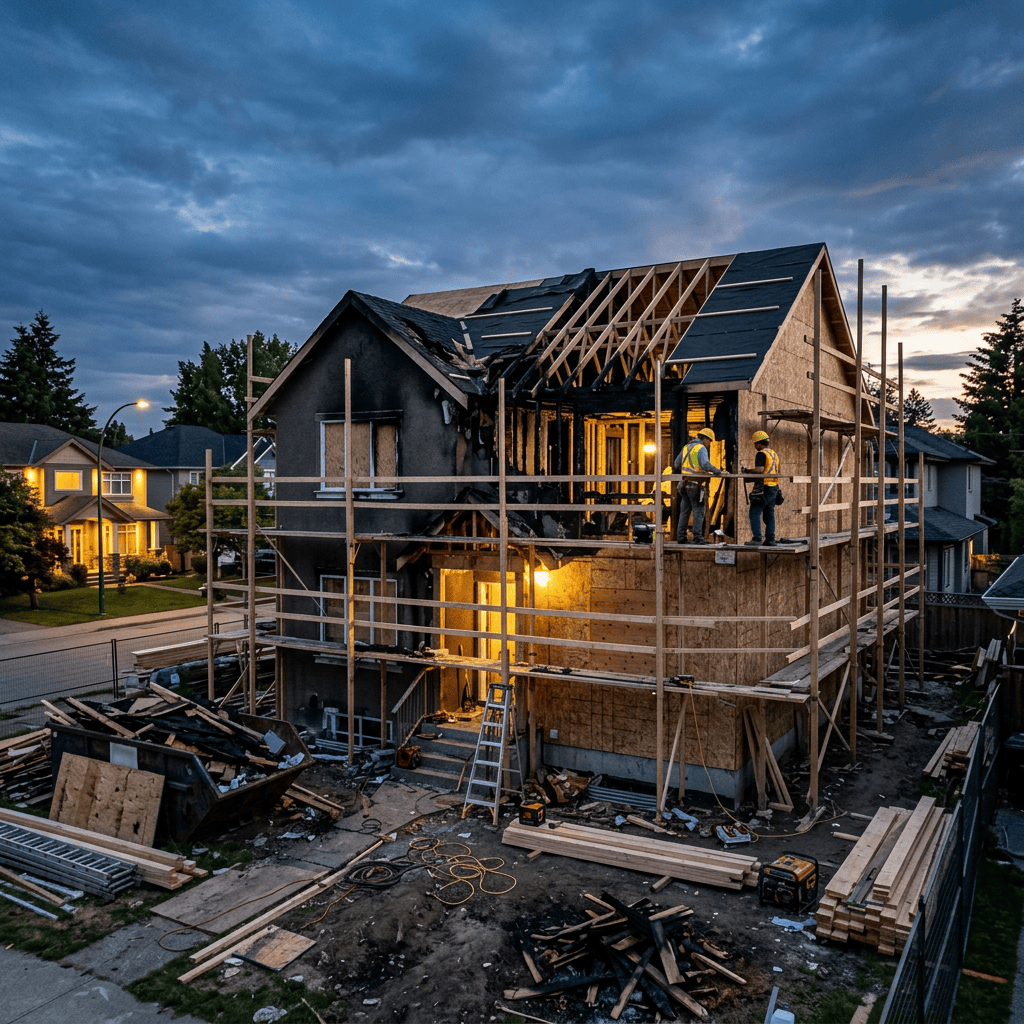
The Construction Project and the Fire
Carnaval Home, LLC retained Berman Construction & Development, Inc. to renovate an existing residence. The contract established September 4, 2019, as the substantial-completion deadline.
The agreement also contained a detailed risk-of-loss provision:
“Owner shall bear the risk of increased labor and materials costs and material and labor shortages. Owner shall bear the risk of loss, costs and damage to the Work caused by natural disasters, vandalism, arson, insect infestation and perils beyond Contractor’s reasonable control.”
Berman hired several subcontractors, including an electrician and a project supervisor. On July 29, 2019, when the renovation was approximately 90 percent complete, a fire destroyed the residence.
The owner sued the contractor and others, asserting claims for breach of contract, negligence, and violation of the Florida Building Code. The breach-of-contract claim was based principally on the contractor’s failure to deliver the renovated property by the contractual completion deadline.
The cause of the fire became the central factual dispute at trial. The owner presented evidence suggesting that faulty electrical wiring in the attic caused the fire. The contractor presented competing evidence supporting its position that the fire resulted from arson or another cause outside its reasonable control.
The evidence was not one-sided. The fire occurred on the same day electrical work was completed and power was restored to the interior of the residence. Witnesses testified that some lights stopped functioning before the fire, and the owner presented expert testimony that the fire likely originated in the attic.
The contractor, however, presented evidence that gasoline residue had been detected, that the property displayed burn patterns consistent with an accelerant, and that the fire may have had multiple points of origin. The contractor also emphasized the speed with which the fire engulfed the structure after the owner’s representative left the property.
Thus, the cause of the fire—and whether it constituted a peril beyond the contractor’s reasonable control—was not collateral to the case. It was potentially dispositive of the owner’s principal contract theory.
The Contractor’s Defenses
The contractor asserted several related defenses.
It contended that the fire made completion impossible, frustrated the purpose of the agreement, and triggered the contract’s risk-of-loss provision. During the charge conference, the contractor requested a special interrogatory asking the jury to determine whether it was excused from performance under those defenses.
The trial court directed a verdict against the contractor on the equitable defenses of impossibility and frustration of purpose. The court reasoned that the parties had expressly allocated the relevant risk in their written agreement and that the contractual provision displaced the equitable defenses.
The Fourth District affirmed that ruling. Citing Vereit Real Estate, L.P. v. Fitness International, LLC, 365 So. 3d 442 (Fla. 3d DCA 2023), the court recognized that when a contract assigns the risk that a future event will prevent performance, the party assuming that risk ordinarily cannot rely on equitable doctrines to avoid the agreed allocation.
That portion of the decision carries a significant drafting lesson. Force-majeure and risk-of-loss provisions do more than supplement common-law defenses. Depending on their language, they may displace those defenses. The express agreement therefore becomes the primary source of the parties’ rights and obligations following an unexpected event.
But while the trial court rejected the contractor’s equitable defenses, the contractor’s contractual defense remained unresolved. The contractor was still entitled to argue that the fire fell within the risk-of-loss language and that the contract therefore excused its nonperformance.
The trial court nevertheless refused to place that question on the verdict form.
The Jury’s Verdict
The verdict form asked whether the owner had substantially performed its contractual obligations, whether the owner had been excused from performing, whether the contractor had failed to perform an essential contractual obligation, and whether the owner had sustained damages as a result.
Notably absent was any corresponding question asking whether the contractor had been excused from performance under the contract’s risk-of-loss provision.
The jury found that the contractor was not negligent. It found that the contractor had violated the Florida Building Code, but also found that the code violations did not cause the owner’s damages. Nevertheless, the jury found that the contractor breached the agreement and awarded the owner $928,850.
The trial court denied the contractor’s post-trial motions and determined that the owner was entitled to recover attorneys’ fees as the prevailing party.
The Verdict Form Must Address Material Affirmative Defenses
The Fourth District held that refusing the requested risk-of-loss interrogatory was an abuse of discretion.
The court relied on the principle that when an interrogatory verdict form is used, the form should address not only the plaintiff’s claims but also the defendant’s affirmative defenses. Otherwise, the jury may not understand that it must evaluate the defenses before imposing liability.
That problem was particularly acute in Berman Construction. The form expressly asked whether the owner had been excused from performing but included no comparable question concerning the contractor. A jury answering whether the contractor “failed to do something essential which the contract required it to do” might reasonably find a literal failure to perform without ever deciding whether the contract excused that failure.
The distinction is fundamental. A party may fail to complete performance without committing an actionable breach if the contract itself excuses performance under the circumstances presented.
The Fourth District concluded that the omitted interrogatory concerned “the major question in the case.” Because the jury was never asked to determine whether the fire resulted from arson or another peril beyond the contractor’s reasonable control, the verdict did not resolve the contractor’s principal contractual defense.
The court therefore reversed the judgment and remanded the case for a new trial.
The Court Rejected an Overly Narrow Reading of the Risk-of-Loss Provision
The owner argued that the provision placed the risk of only specifically identified events—including arson—on the owner. Under that interpretation, the contractor would bear the risk of an accidental fire that did not result from arson.
The owner relied on expressio unius est exclusio alterius, the interpretive canon under which the express inclusion of one matter may imply the exclusion of others.
The Fourth District rejected that interpretation.
The provision did not stop after listing “natural disasters, vandalism, arson, [and] insect infestation.” It also included the broader phrase “and perils beyond Contractor’s reasonable control.”
That concluding language functioned as a catchall. Applying the negative-implication canon to limit the provision to the specifically enumerated events would effectively read the catchall out of the contract.
Accordingly, the contractual provision was not limited to arson. It placed the risk on the owner for any peril beyond the contractor’s reasonable control. The jury therefore needed to decide not only whether the fire resulted from arson, but also whether it resulted from some other cause outside the contractor’s reasonable control.
This portion of the opinion reinforces a familiar but important rule of contract interpretation: enumerated examples do not necessarily limit broader language that follows them. The contract must be read as a whole, and courts generally should not adopt an interpretation that renders material language meaningless or superfluous.
The Inconsistent-Verdict Issue Was Not Properly Preserved
The contractor also argued that the jury’s findings were inconsistent. According to the contractor, the jury’s determination that it was not negligent, combined with the finding that its building-code violations did not cause the loss, could not be reconciled with the conclusion that it was contractually responsible for the fire damage.
The Fourth District declined to grant relief on that theory.
An inconsistent verdict occurs when two material factual findings are mutually exclusive and cannot stand together. But an objection to an inconsistent verdict ordinarily must be raised before the jury is discharged. That procedure allows the trial court to resubmit the matter to the same jury for clarification.
The contractor did not raise the asserted inconsistency before the jury was discharged. It also sought a directed verdict rather than a new trial. The appellate court explained that even when an inconsistent verdict is properly preserved, the usual remedy is a new trial—not entry of judgment for the dissatisfied party.
The preservation lesson is straightforward: counsel must scrutinize the verdict immediately when it is returned. Waiting until post-trial proceedings may forfeit an otherwise substantial objection.
Practical Lessons for Florida Construction Disputes
The decision provides several practical lessons for owners, contractors, developers, and counsel.
1. Risk allocation should be addressed before construction begins.
A well-drafted construction contract should identify who bears the risk of loss while work is in progress, who must maintain builder’s-risk and property insurance, and how casualty damage affects payment and completion obligations.
Generic force-majeure language may be inadequate. The agreement should distinguish among delay, increased cost, partial destruction, total destruction, negligent loss, and losses beyond either party’s control.
2. Insurance provisions and risk-of-loss provisions must work together.
Assigning contractual risk to one party is not the same as confirming that insurance exists to cover that risk. Construction agreements should coordinate their indemnity, insurance, waiver-of-subrogation, casualty, and risk-of-loss provisions.
Otherwise, a party may discover only after a catastrophic event that it contractually assumed a loss for which no adequate coverage exists.
3. Contractual defenses must be translated into jury questions.
Pleading an affirmative defense is only the beginning. Counsel must develop the defense through discovery, support it with admissible evidence, request an appropriate jury instruction, and ensure that the verdict form permits the jury to decide it.
A verdict form that addresses only the plaintiff’s prima facie case may effectively remove a defense from the jury’s consideration even when evidence supporting the defense has been admitted.
4. Proposed verdict forms should be developed early.
Verdict forms should not be treated as an administrative detail to be addressed at the end of trial. In a complex commercial or construction case, the verdict form often determines how the jury conceptualizes the dispute.
Each material claim, counterclaim, affirmative defense, causation issue, and damages category should be mapped to a proposed interrogatory well before trial.
5. Counsel must preserve verdict objections before the jury is discharged.
When the jury returns its verdict, trial counsel should compare each answer against the pleadings, instructions, evidence, and other findings. Any apparent inconsistency should be raised immediately.
Once the jury is discharged, the ability to correct an ambiguous or inconsistent verdict becomes substantially more limited.
Conclusion
Berman Construction is not simply a verdict-form case. It demonstrates how contract drafting, evidentiary presentation, preservation, and trial procedure intersect in construction litigation.
The contractor obtained a new trial because it consistently maintained that the parties’ agreement placed the relevant risk on the owner and because it requested a jury interrogatory addressing that defense. But the case also shows the cost of procedural missteps: the contractor’s inconsistent-verdict argument was not preserved, and its equitable defenses failed because the written contract governed the risk.
The broader lesson is that sophisticated construction litigation begins with the contract but does not end there. The contractual allocation of risk must be carried through the pleadings, discovery, expert proof, jury instructions, verdict form, and post-verdict proceedings. A strong substantive defense can be lost—or an otherwise substantial judgment reversed—depending on whether those procedural components are properly aligned.
 Donner Law Firm