
By Jeffrey T. Donner, Esq.
July 30, 2026
A recent decision from Florida’s Fourth District Court of Appeal provides an important reminder that a supplier may qualify as a “materialman” under Florida’s Construction Lien Law and still have no enforceable lien against the improved property.
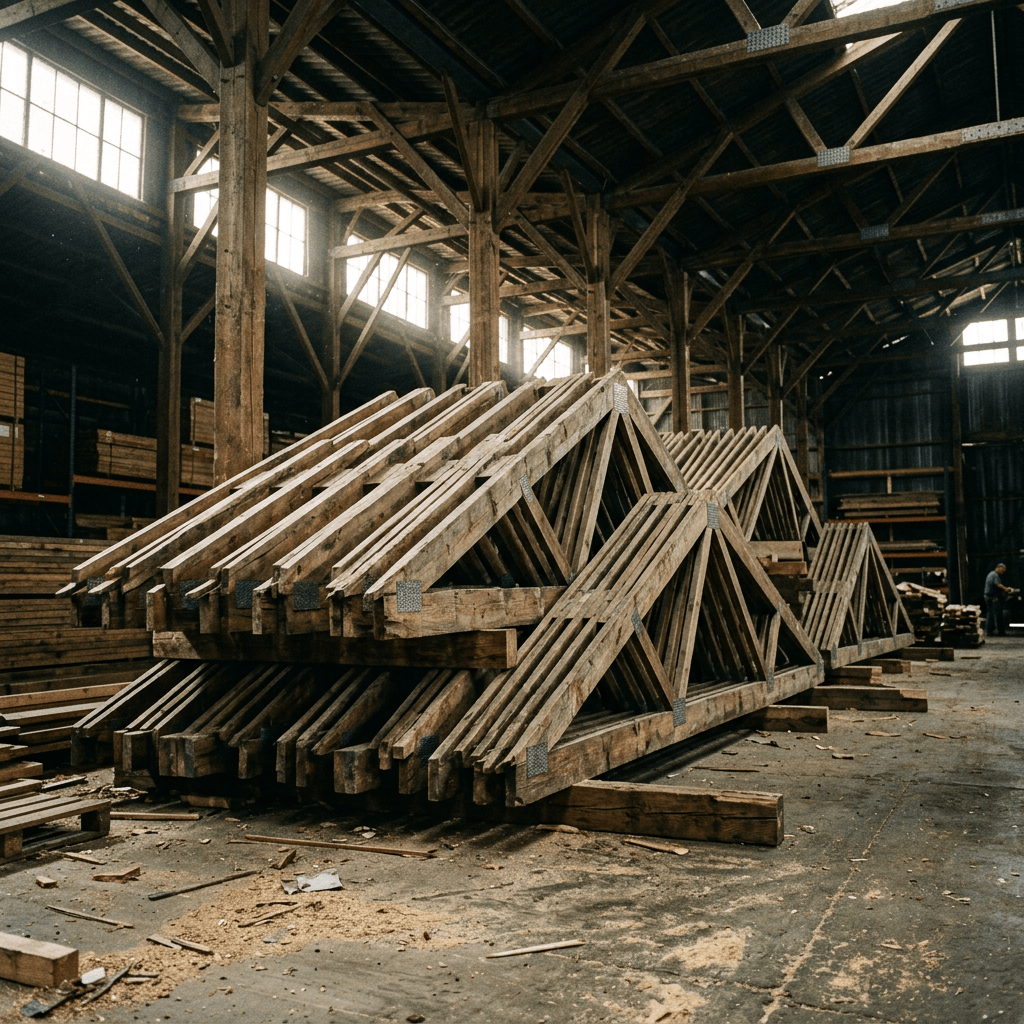
In JM Properties of W. Palm Beach, Inc. v. Fort Dallas Truss Company, LLC, 429 So. 3d 539 (Fla. 4th DCA 2026), the court held that a truss manufacturer was properly classified as a materialman, even though it performed no work at the project site. Nevertheless, because the trusses were never delivered and the property received no permanent benefit from them, the supplier was not entitled to enforce a construction lien.
The decision highlights a distinction that frequently matters in construction disputes: the existence of a valid contract claim does not necessarily establish a valid construction lien.
The Contract and the Dispute
The property owners originally retained a contractor for a construction project. After that contractor stopped working, the owners hired JM Properties of W. Palm Beach, Inc. as the replacement contractor.
JM Properties then contracted with Fort Dallas Truss Company, LLC to design, manufacture, and deliver trusses for the project. Under the contract, JM Properties was required to pay 50 percent of the contract price upon completion of the shop drawings.
The trial court found that Fort Dallas completed the shop drawings and advised JM Properties that the initial payment was due. JM Properties did not make the payment and, according to the trial court’s findings, avoided further communication with Fort Dallas.
Fort Dallas did not deliver the trusses. Instead, it recorded a construction lien against the owners’ property for $28,408.50, representing 50 percent of the contract price plus sales tax. It then sued JM Properties for breach of contract and sought to foreclose the lien.
JM Properties transferred the lien from the real property to a cash bond under Florida’s lien-transfer procedure. The posted bond totaled $40,215.07 and included the amount demanded in the claim of lien, three years of projected interest, and an additional sum for recoverable attorney’s fees and costs.
The Supplier Was a Materialman, Not an Unlicensed Contractor
JM Properties argued that Fort Dallas could not enforce the contract because Fort Dallas was not a licensed contractor or engineer.
The Fourth District rejected that argument and affirmed the trial court’s determination that Fort Dallas was acting as a materialman rather than as a contractor.
Section 713.01(20), Florida Statutes, defines a materialman to include a person who furnishes materials under contract to an owner, contractor, subcontractor, or sub-subcontractor, including specially fabricated materials produced off-site for a particular improvement, so long as the supplier performs no labor in installing those materials.
The evidence established that Fort Dallas was retained to manufacture and deliver trusses and performed no installation work at the construction site. Accordingly, competent, substantial evidence supported the trial court’s factual finding that Fort Dallas was a materialman.
That portion of the opinion is significant because it confirms that a fabricator does not become an unlicensed contractor merely because its work includes design-related or preparatory activity associated with manufacturing building components. The analysis turns on the supplier’s contractual role and the work actually performed, including whether the supplier undertook installation or other construction activity requiring licensure.
Materialman Status Did Not Create a Right to Lien
The more consequential portion of the opinion concerned whether Fort Dallas could enforce its lien.
The Fourth District held that it could not.
Florida’s Construction Lien Law does not grant lien rights merely because a claimant falls within a statutory category of potential lienors. The lien must arise from labor, services, or materials furnished for an “improvement” to real property.
Section 713.01(15), Florida Statutes, defines an improvement as construction or related work performed on real property “for its permanent benefit.”
In JM Properties, the trusses were never delivered to the project. As a result, they were never incorporated into the structure, placed on the property, or otherwise used to provide a permanent benefit to the property.
The Fourth District relied on its earlier decision in Palm Beach Mall, Inc. v. Southeast Millwork, Inc., 593 So. 2d 1121 (Fla. 4th DCA 1992), which recognized that a lien cannot be imposed when the work or materials at issue did not permanently benefit the property.
The court therefore reversed the portion of the final judgment directing the clerk to release $28,408.50 from the lien-transfer bond to Fort Dallas.
The Breach-of-Contract Claim Survived
Although Fort Dallas lost its construction-lien remedy, it did not necessarily lose its right to recover against JM Properties.
The Fourth District expressly distinguished between the lien claim and the contract claim. The trial court had found that JM Properties breached the parties’ agreement by failing to make the required payment after completion of the shop drawings. That contractual breach could support a damages award even though the supplier had no valid lien against the real property.
The appellate court remanded the case for the trial court to determine the proper measure of damages on the breach-of-contract claim.
That remand may require consideration of several traditional contract-damages principles, including the payment provisions of the agreement, the value of the work actually performed, any avoided manufacturing or delivery costs, and whether the contract authorized recovery of a fixed progress payment upon completion of the shop drawings.
The opinion does not establish that Fort Dallas was automatically entitled to the full amount stated in its lien. Instead, the trial court was directed to determine the damages recoverable under the contract rather than treating the lien amount as dispositive.
Why the Distinction Matters
Construction litigation frequently involves overlapping remedies that arise from the same underlying transaction. A contractor, subcontractor, or supplier may have a strong breach-of-contract claim but a defective or unenforceable construction lien.
The distinction matters for several reasons.
First, a construction lien creates rights against the improved property, while an ordinary contract claim generally runs only against the contracting party. A valid lien can provide substantial leverage by exposing the property to foreclosure and by creating title, financing, and sale complications for the owner.
Second, Florida’s Construction Lien Law contains specialized procedures, deadlines, notice requirements, and attorney’s-fee provisions. A claimant that improperly records or enforces a lien may face consequences that do not arise in a conventional contract action.
Third, transferring a lien to a bond does not validate an otherwise defective lien. The bond substitutes for the property as security, but the lienor must still prove that the underlying lien was legally enforceable. In JM Properties, the fact that the contractor posted more than $40,000 to transfer the lien did not entitle the supplier to recover against the bond.
Finally, the decision illustrates why parties should separately analyze liability, damages, licensure, lien entitlement, and lien perfection. Those issues overlap, but they are not interchangeable.
Practical Considerations for Suppliers of Custom Materials
Businesses that manufacture trusses, windows, millwork, cabinetry, structural components, or other specially fabricated materials should pay close attention to when contractual payment rights arise and when statutory lien rights become available.
A supplier may be able to require payment for design, engineering coordination, shop drawings, procurement, or fabrication before delivery. Those contractual payment obligations may be enforceable even if the materials are never delivered.
But the supplier should not assume that every unpaid contractual amount can be secured through a construction lien. Where the materials are never delivered, incorporated, or otherwise used for the permanent benefit of the property, a lien may be vulnerable even though the customer has plainly breached the contract.
Suppliers can reduce that risk through careful contracting. Among other things, agreements should clearly identify progress-payment milestones, cancellation charges, ownership of shop drawings, fabrication deposits, restocking or demobilization charges, and the measure of damages if the purchaser terminates or refuses to proceed.
The contract should also distinguish between sums recoverable as contractual damages and amounts that may lawfully be included in a claim of lien.
Practical Considerations for Owners and Contractors
Owners and contractors should not assume that a recorded lien is enforceable merely because the claimant provided some project-related service or manufactured project-specific materials.
When materials were never delivered, counsel should investigate whether the property actually received the permanent benefit required by the statute. The same inquiry may arise when materials were manufactured but diverted to another project, retained by the supplier, sold to another customer, or never incorporated into the improvement.
At the same time, defeating the lien does not eliminate potential contract liability. An owner or contractor may successfully discharge or defeat a lien and still remain liable for breach of contract, lost profits, reliance damages, or other recoverable amounts.
The appropriate strategy therefore depends on the client’s objectives. In some cases, the principal concern is clearing title or releasing bonded funds. In others, the central dispute concerns the underlying contract balance and the amount of recoverable damages.
The Broader Lesson
JM Properties reinforces a basic but sometimes overlooked principle of Florida construction law: lien rights are statutory and must satisfy statutory requirements independent of the parties’ contract.
Fort Dallas was a materialman. JM Properties breached the contract. But because the trusses were never delivered and the property received no permanent benefit, Fort Dallas had no enforceable lien against the property or the substituted lien-transfer bond.
For contractors, suppliers, and property owners, the case is a useful reminder to analyze the contract claim and the lien claim separately. A party may prevail on one and lose on the other.
This article is provided for general informational purposes and does not constitute legal advice. Construction-lien rights are highly dependent on the applicable contracts, notices, dates, project relationships, and statutory procedures. Parties facing a construction payment or lien dispute should obtain advice based on the specific facts of the matter.
 Donner Law Firm